Clinical Mindset
Clinical Conversation No. 1
The 0.05-Second Thought That Makes Phlebotomy Students Miss
By Dorian Vale · 5 min read
Published for Phlebotomy Students and Future Clinicians
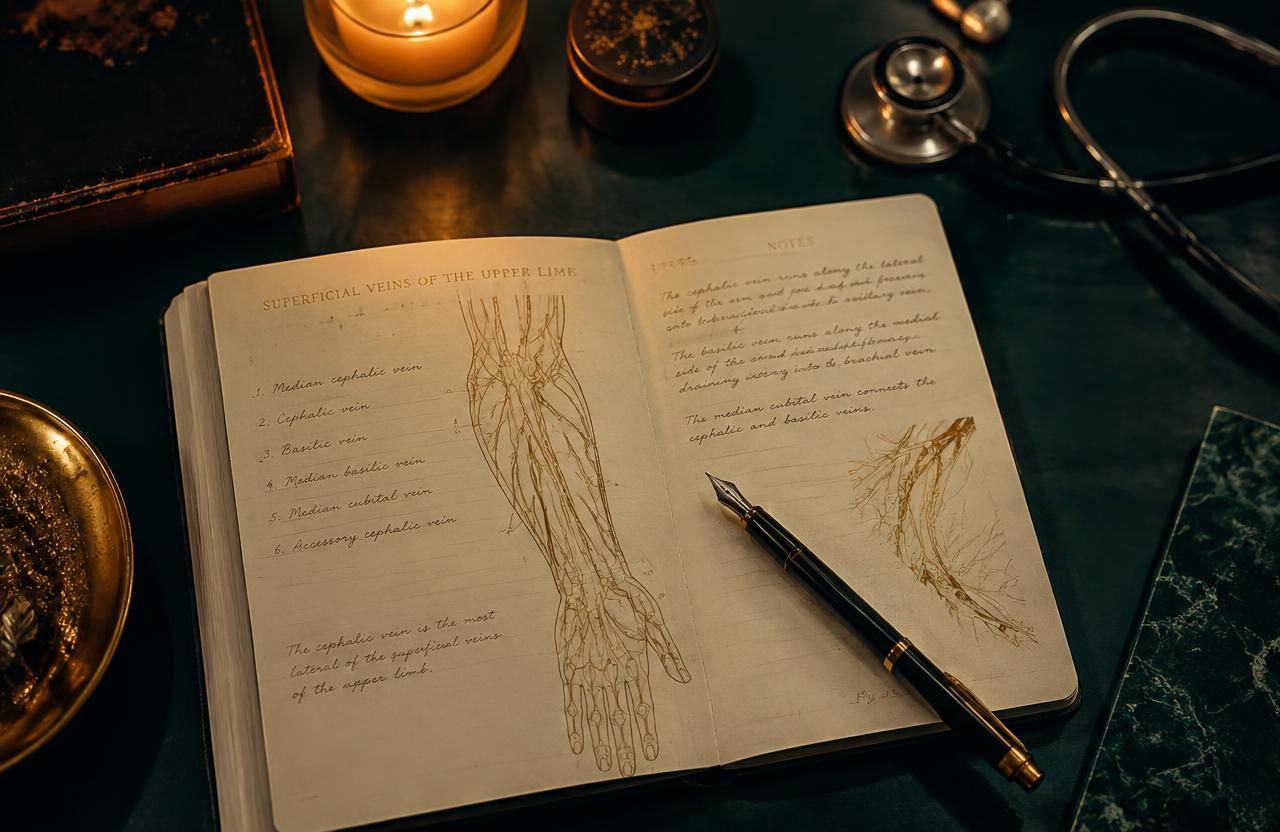
Room 12, Left Arm
The median cubital is sitting right under your index finger — full, springy, the kind of vein your instructor would tap and call a gift. The tourniquet is on, the site is cleaned and dry, and your thumb has the skin pulled taut below it.
You uncap the needle, line up the bevel, and for one clean moment you know this one is yours. Then a thought arrives faster than you can name it: what if I miss?
Nothing about the vein changed in that instant, and nothing about the patient did either. But your wrist tightened, your thumb eased off a few millimeters, and the needle arrived just to the side of where you’d aimed.
The Half-Second Nobody Talks About
Afterward, almost every student tells the same story — the vein rolled, the patient flinched, the angle was off. It wasn’t the vein. It was the half-second your mind left the procedure to argue with itself.
Doubt doesn’t make you miss — the way your hands respond to doubt does. That’s the line worth underlining, because it means the miss happened in your body before it ever happened at the skin.
What Your Hands Do When Your Mind Interrupts
There’s a well-studied reason this happens. A movement you’ve practiced enough runs mostly on its own, but the moment pressure makes you start consciously supervising it — checking each finger, each degree — it gets stiffer and less accurate. Athletes call it choking, and it shows up the same way at the bedside as it does at the free-throw line.
Add the small surge of adrenaline that rides along with “what if I miss,” and the effects land exactly where venipuncture can’t afford them. Your grip tightens on the holder, fine control in your fingertips drops, and your anchor hand — the one you stopped paying attention to — quietly softens.
One miss also rarely stays one miss. The second stick happens with a more anxious patient and your doubt now backed by fresh evidence, so the next “what if” shows up louder and earlier. Left alone, a half-second of doubt can grow into a habit of hesitation that follows you from room to room.
The Pianist Who Looks Down
Picture a pianist who has rehearsed a passage a hundred times. She plays it cleanly right up until the moment she glances down to check her fingers — and that’s precisely where she stumbles, because the music was never stored in anything she could watch.
Venipuncture works the same way. The careful part of your mind belongs in the rehearsal, not the performance — and once the cap is off, you’re performing.
Think Zone vs. Trust Zone
The fix isn’t to stop thinking, because careful thinking is what keeps patients safe. The fix is deciding ahead of time when you think, and drawing a hard line at one physical moment — the needle cap coming off.
Before the cap comes off, you’re in the Think Zone. Palpate again, trace the vein’s direction with your finger, check the patient’s arm position, and question anything that feels wrong — this is where doubt earns its keep.
After the cap comes off, you’re in the Trust Zone. The decisions are already made, and your only job is to carry out the plan you just built rather than reopen it mid-insertion.
There is one honest exception. If something genuinely changes — the patient jerks their arm, the vein flattens, you lose the bounce under your finger — that’s new information, not doubt, so pause before inserting and reassess according to your facility’s protocol. That’s judgment, and judgment is never the thing you’re trying to silence.
The Cap-Off Reset
Run this in the few seconds before the cap comes off. It takes less time than the doubt does.
- Finish every question while the cap is still on — site, direction, depth, tube order, arm position.
- Take one slow exhale through your nose and let your shoulders drop before you uncap.
- Press into your anchor until you feel the skin firm under your thumb, then keep that pressure exactly where it is.
- Put your eyes on the insertion point, not on the needle in your hand.
- If “what if I miss?” shows up after the cap is off, answer it once — “I already decided” — and move.
None of this makes the thought disappear. It just stops the thought from steering your hands.
Hearing the Thought Means You’re Paying Attention
If you’ve felt that flash of doubt, you’re not uniquely nervous and you’re not bad at this. Every clinician you admire has heard the same question in the same half-second — the difference is they stopped letting it vote after the cap came off.
Catching the thought is the first real sign you’re building control over it. Students who never notice it are still at its mercy, and you’ve already started drawing the line.
Before Your Next Draw
Answer these honestly before your next shift. Writing them down works better than running them through your head.
When does doubt usually show up for me — before the cap comes off, or after?
What happens in my hands in the half-second after I think “what if I miss?”
What would I do differently if I trusted the plan I’d already made?
Save This One
Save this article for the night before your next clinical, and read the Think Zone section once more before you sleep. Tomorrow, when the thought shows up, you’ll recognize it for what it is — a half-second of noise arriving after the decisions were already made.
The Think Zone work itself — palpation, vein direction, anchoring, angle — is covered step by step in Phlebotomy: The Veteran’s Field Manual, so the decisions you make before the cap comes off are ones you can actually trust. That’s what lets the Trust Zone stay quiet.
Think with the cap on. Trust with the cap off.
Educational disclaimer: This article is supplemental educational information and does not replace accredited training, current professional standards, institutional procedures, or supervised clinical instruction. Read the full disclaimer.
Related Articles
Clinical Mindset
The Depth Panic Mistake That Causes Students to Miss Perfect Veins
Before your last draw, could you have answered that question? Not in general terms from a textbook, but for that specific vein, in that specific arm, right before the needle…
Read Article →Clinical Mindset
Most Students Blame the Angle. The Anchor Was the Real Problem.
Think back to your last missed draw and the explanation you gave afterward, out loud or just to yourself. For most students, it’s some version of the same sentence: “My angle…
Read Article →
Clinical Mindset
When One Correction Becomes Five
The tube is filling, just slower than you’d like, so you advance the needle a hair. The flow stops completely.
Read Article →